How to clean vinyl records
Brush every record with an anti-static or carbon-fibre brush before you play or record it. Wash dirty records with distilled water and a little mild, fragrance-free soap, wiping along the grooves and keeping the label dry, then rinse with distilled water, dry the record completely and put it in a new polyethylene inner sleeve. That's close to how sound archives such as the Library of Congress clean records, and it matters before recording: dirt in the grooves turns into clicks and crackle in every copy you make.
Handle records by the edges
Hold a record by its edge and its label, never the playing surface. IASA, the International Association of Sound and Audiovisual Archives, warns that sweat and skin deposits attract dust, can encourage mould and add noise when the record plays. Clean on a clear, dust-free surface, with everything you need laid out before you take the record out of its sleeve.
Four ways to clean a vinyl record
Start with the gentlest method and only go further if the record still needs it. Archives work the same way: the Library of Congress recommends starting with dry methods such as antistatic brushing before moving to wet cleaning.
Scroll the table sideways to see every column.
| Method | Best for | What you need | What archives say |
|---|---|---|---|
| Dry brush | Dust and static, before every play or recording | An anti-static or carbon-fibre record brush | Start with dry methods, such as antistatic brushing (Library of Congress) |
| Wash by hand | Fingerprints, grime and dust that brushing leaves behind | Distilled water, mild fragrance-free soap, a soft brush or microfibre cloth, a way to keep the label dry | Water with a mild detergent, keeping the label dry (IASA) |
| Vacuum machine | Deep cleaning, or a whole collection | A record-cleaning machine with a vacuum arm | Washing is the most effective method; machines apply fluid, then vacuum it off (IASA) |
| Ultrasonic cleaner | Very dirty records | An ultrasonic record-cleaning bath | "May be effective" (IASA) |
Dry brushing: before every play
Hold the brush lightly on the record while it turns for a few rotations, then angle it off the edge so the dust comes with it. Do this every time you play or record a record.
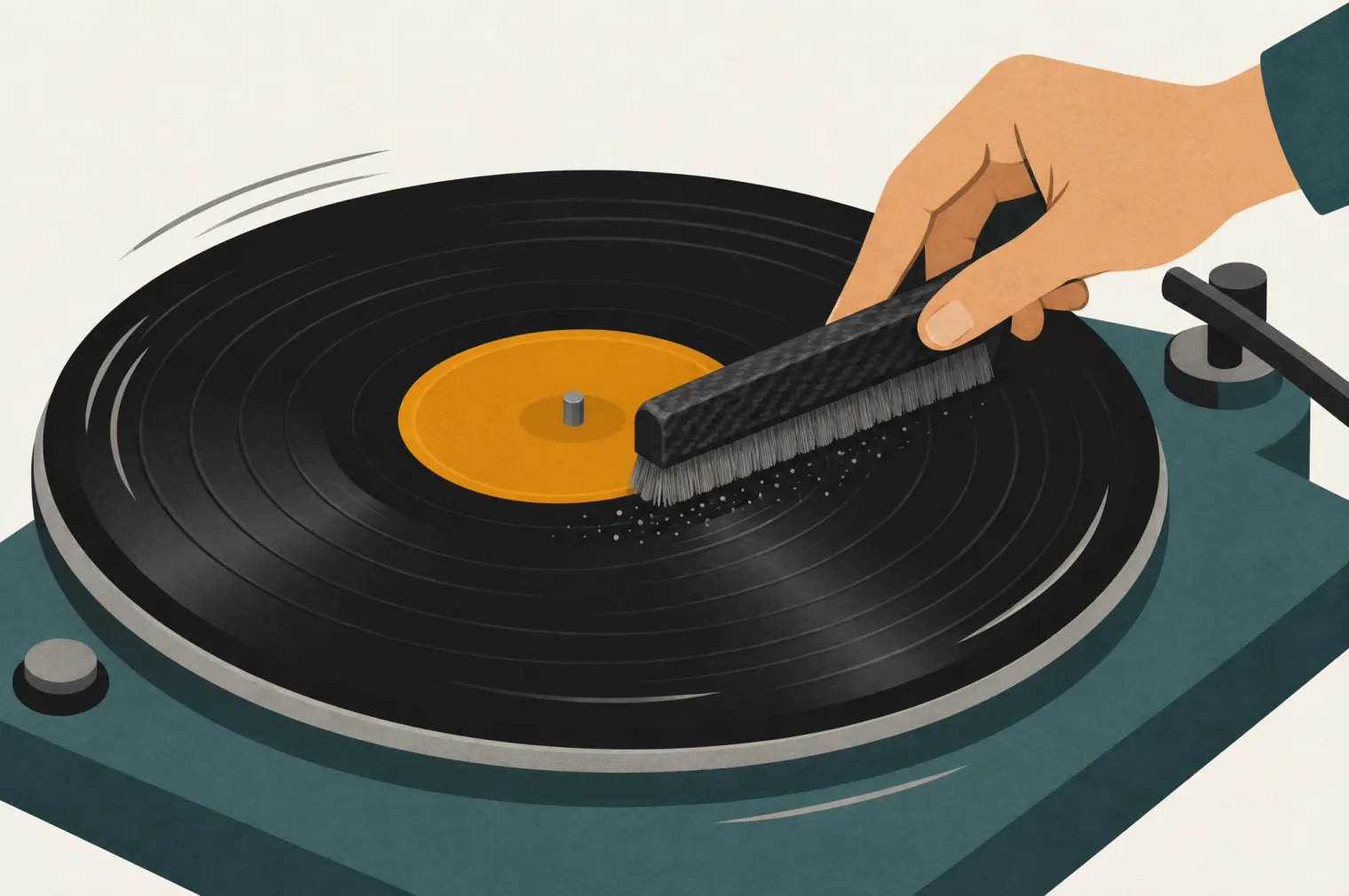
A brush only moves loose dust. Static holds dust to the surface, and the CLIR preservation guide points out that dry wiping on its own can make dust jump straight back. If a record still crackles after brushing, wash it.
Washing a record by hand
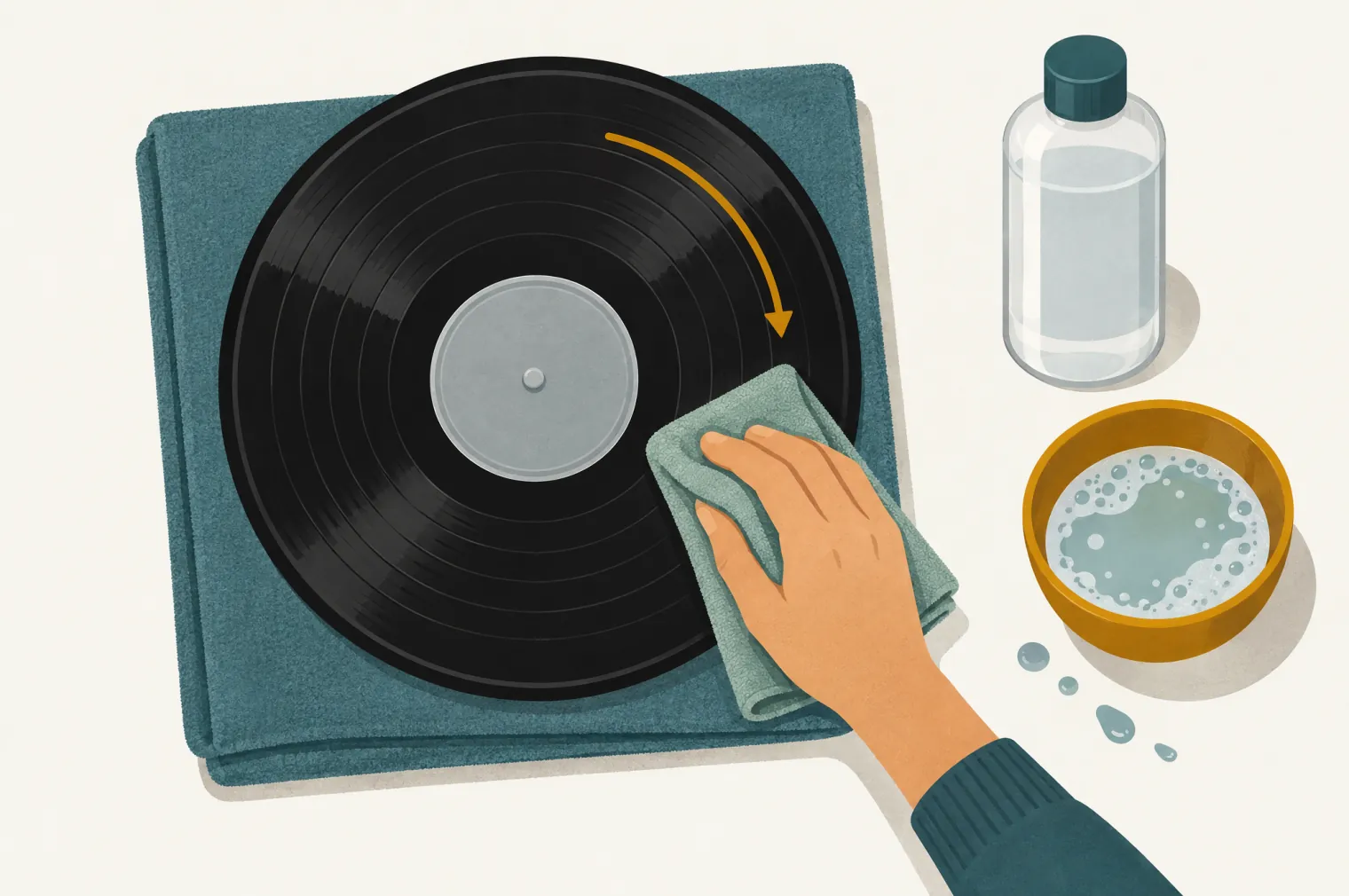
- Brush off loose dust first.
- Mix distilled or deionized water with a little mild, fragrance-free liquid soap.
- Keep the label dry: use a label protector, or work carefully around it.
- Wipe gently along the grooves, never across them, with a soft brush or a microfibre cloth.
- Rinse with distilled water only, so no soap is left in the grooves.
- Dry the record completely: pat along the grooves with a clean microfibre cloth, then let it air-dry standing up before it goes back in a sleeve.
This follows archive practice. IASA's guidelines call for distilled water, cleaning that follows the groove, and thorough drying afterwards.
Vacuum record-cleaning machines
A record-cleaning machine spreads fluid over the record as it turns, then sucks the fluid and dirt out of the grooves with a vacuum arm. IASA calls washing the most effective way to clean records, and machines are how archives do it at scale. The Library of Congress cleaned the discs for its National Jukebox with a mild Tergitol and distilled-water solution, a soft brush and a vacuum, then repeated the process with distilled water alone to rinse off any residue.
If you're digitizing a whole collection, a machine is worth considering: it does the same job as hand washing, faster.
Ultrasonic cleaners
An ultrasonic cleaner lowers the record into a water bath and uses high-frequency sound to shake dirt out of the grooves. IASA's guidelines say ultrasonic cleaning may be effective, but we found little published testing of home units, so follow the maker's instructions. Whatever fluid you use, IASA rules out cleaning solutions that don't disclose what's in them.
What to avoid
- Touching the grooves. Skin oils attract dust and can encourage mould.
- Playing a dirty record to clean it. A Library of Congress report notes that using the stylus to clean the grooves does more damage to vinyl, especially if the record hasn't been cleaned first.
- Alcohol on 78s and lacquer discs. IASA warns that shellac and lacquer discs should never be exposed to alcohol, which may corrode them immediately. For vinyl, archives disagree: IASA allows isopropyl alcohol for greasy deposits, while the same Library of Congress report says not to use alcohol on any disc record except Edison Diamond Discs. If in doubt, leave it out.
- Soap with perfume or other additives, and cleaning fluids that don't list their ingredients.
- Wiping across the grooves or rubbing hard. Clean along the grooves, gently.
- Putting a clean record back in a dirty sleeve.
Dry, sleeve and store
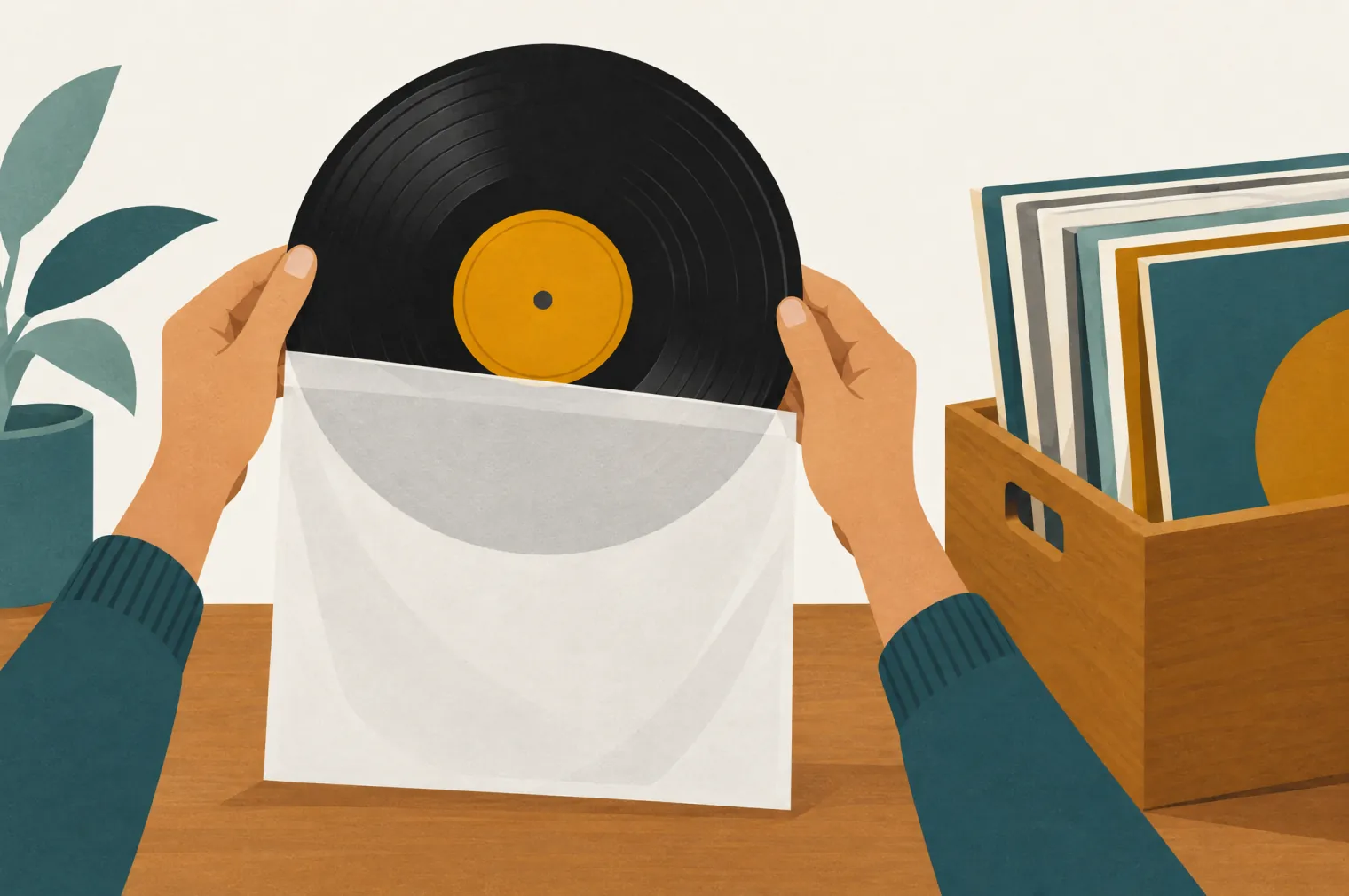
Once a record is completely dry, put it in a new soft polyethylene inner sleeve. CLIR's guide to caring for sound recordings advises against paper, cardboard and PVC sleeves. Store records upright and away from heat, which IASA lists as a particular threat to vinyl.
Don't forget the stylus
A dirty stylus drags dirt through the groove and dulls the sound. Brush it gently from the back of the cartridge to the front, in the direction the record turns, and never side to side, as Audio-Technica advises. Our checklist for preparing records for recording covers the stylus, turntable setup and a test recording.
Questions about cleaning records
What's the best way to clean vinyl records at home?
Brush records before every play, and wash dirty ones with distilled water and a little mild, fragrance-free soap, wiping along the grooves, rinsing with distilled water and drying them completely. If you have a lot of records, a vacuum record-cleaning machine, which sucks the fluid and dirt out of the grooves, is the best option according to CLIR's preservation guide.
Can I use tap water to clean vinyl records?
Use distilled or deionized water instead. It's what sound archives such as the Library of Congress and IASA use, and it doesn't leave minerals in the grooves as it dries.
Is isopropyl alcohol safe for vinyl records?
Archives disagree. IASA allows isopropyl alcohol to remove greasy deposits from vinyl, while a Library of Congress report says not to use alcohol on any disc record except Edison Diamond Discs. Never use it on shellac 78s or lacquer discs, which alcohol can damage straight away.
How often should I clean my records?
Brush a record every time you play or record it; CLIR's preservation guide says records should be cleaned before each playback. Wash a record when it's visibly dirty, when brushing doesn't stop the crackle, or when it's new to your collection.
Does cleaning a record get rid of clicks and pops?
It removes clicks and crackle caused by dust and dirt, but not those from scratches or worn grooves. For what's left after recording, VinylFlow's Clean Up Clicks & Rumble softens clicks and removes low-frequency rumble.
Sources
- Library of Congress: care, handling and storage of audio-visual materials, How do I clean my grooved discs?, Making the National Jukebox.
- CLIR and Library of Congress: Capturing Analog Sound for Digital Preservation (dry methods first, mild soap, alcohol, stylus cleaning), The Care and Handling of Recorded Sound Materials (static, machines, sleeves, cleaning before each playback).
- IASA: TC-04 5.3.3, cleaning LP records (handling, washing, machines, ultrasonic, isopropyl alcohol), TC-04 5.2, historical formats (no alcohol on shellac or lacquer), TC-05 3.8, cleaning of carriers (follow the groove, distilled water, dry thoroughly), TC-05, handling and storage (sleeves, heat).
- Audio-Technica: how to clean a stylus.
Clean records, then record them
Once your records are clean, VinylFlow splits your recordings into tracks, tags them from Discogs and exports FLAC, MP3 or AIFF. Free for macOS, Windows and Docker.